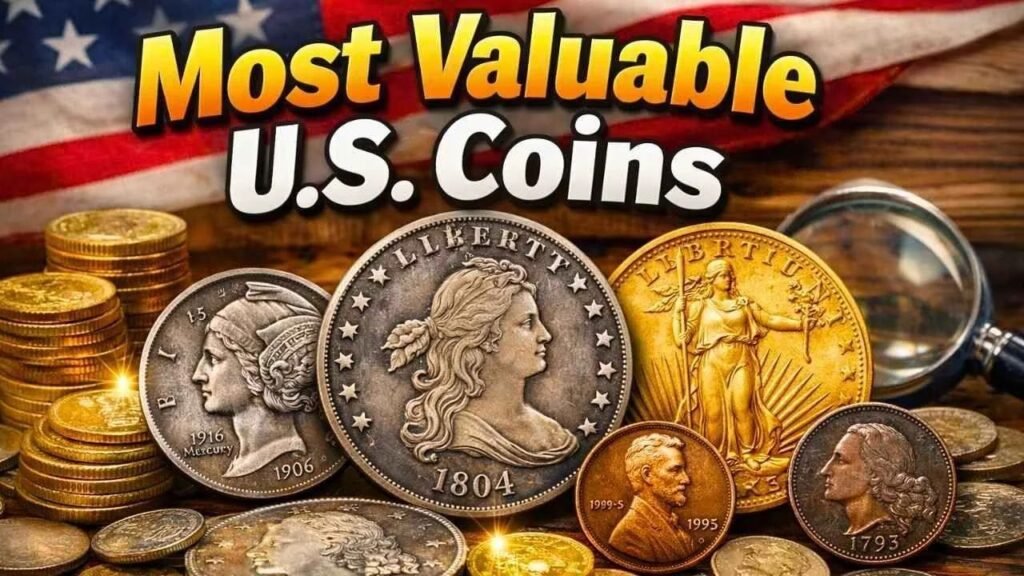
The history of American coinage reflects more than monetary evolution—it represents a timeline of national identity, technological advancement, and economic transformation. While billions of coins have circulated through everyday life, only a select few have reached legendary status in the world of numismatics.
In 2026, the market for ultra-rare U.S. coins remains exceptionally strong. Driven by global collectors, high-net-worth investors, and institutional demand, top-tier coins continue to achieve multimillion-dollar valuations at major auctions.
This guide explores the most valuable U.S. coins in circulation history, why they command extraordinary prices, and what makes them enduring assets in modern investment portfolios.
Why Rare U.S. Coins Command Extraordinary Value
The value of elite American coins is built on three foundational pillars: rarity, condition, and historical significance.
Extreme Rarity
Some coins exist in extremely limited quantities, while others survived accidental minting errors or political decisions that restricted their release. In many cases, only a handful are known to exist.
Exceptional Condition
Coins preserved in near-perfect condition often achieve exponential value increases. Even minor differences in grade can dramatically impact auction outcomes.
Historical Importance
Coins tied to major events—such as the founding of the U.S. Mint, economic crises, or gold standard changes—carry deep historical appeal that enhances long-term demand.
Together, these factors create some of the most competitive bidding environments in the collectibles market.
The Most Valuable U.S. Coins in 2026
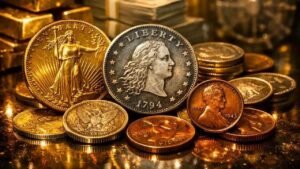
Below are the most iconic and valuable coins that continue to define elite numismatics.
1794 Flowing Hair Silver Dollar
Widely regarded as the first silver dollar struck by the United States Mint, the 1794 Flowing Hair Dollar represents the beginning of federal coinage.
Fewer than 150 examples are believed to survive today, making it one of the rarest foundational coins in existence. High-grade specimens have achieved prices exceeding $10 million, reflecting both scarcity and historical significance.
This coin remains a cornerstone of elite collections worldwide.
1933 Double Eagle
The 1933 Double Eagle is arguably the most famous U.S. coin ever produced. Originally minted in gold, it was never officially released due to the United States abandoning the gold standard during the Great Depression.
Most examples were melted, but a small number survived through extraordinary circumstances. One legally sold specimen achieved over $18 million at auction, making it one of the most valuable coins in history.
Its blend of mystery, legality, and beauty ensures continued global fascination.
1913 Liberty Head Nickel
With only five known examples, the 1913 Liberty Head Nickel is one of the rarest coins ever confirmed.
Its origins remain partly mysterious, adding intrigue to its already extraordinary scarcity. Over the years, it has sold for more than $5 million, with demand consistently remaining strong among elite collectors.
It is considered a true numismatic legend.
1804 Draped Bust Silver Dollar
Known as the “King of American Coins,” the 1804 Draped Bust Dollar holds legendary status in the collecting world.
Interestingly, most examples were not struck in 1804 but were later produced as diplomatic presentation pieces. Only around 15 specimens exist across all categories.
Depending on condition and provenance, values frequently exceed $7 million, making it one of the most sought-after U.S. coins ever created.
1787 Brasher Doubloon
Privately minted by goldsmith Ephraim Brasher before the establishment of the U.S. Mint, the Brasher Doubloon represents early American craftsmanship and entrepreneurial spirit.
Struck in gold, it predates formal federal coinage and stands as a symbol of pre-constitutional currency experimentation.
Exceptional examples have sold for more than $9 million, placing it firmly among America’s most valuable historic coins.
Million-Dollar Error Coins
Not all valuable coins were intentionally designed. Some of the most expensive examples in U.S. numismatics are the result of dramatic minting errors.
1943 Bronze Lincoln Cent
During World War II, pennies were intended to be struck in steel to conserve copper for military needs. However, a small number were mistakenly struck on bronze planchets.
These rare survivors have sold for over $1 million, making them one of the most famous error coins in American history.
1944 Steel Lincoln Cent
In a reversal of the 1943 error, a few steel blanks were mistakenly used in 1944 when copper production resumed.
These coins are extremely rare and have reached seven-figure valuations in exceptional condition.
1955 Doubled Die Lincoln Cent
One of the most visually dramatic error coins, the 1955 Doubled Die features strong doubling in the date and inscriptions.
While many examples sell for thousands, pristine specimens in elite condition have approached or exceeded the million-dollar range.
Its bold appearance makes it highly recognizable and consistently in demand.
2000-P Sacagawea Mule Error
This modern rarity features an extraordinary minting mistake: a Washington quarter obverse paired with a Sacagawea dollar reverse.
Only a limited number are known to exist. Verified examples have sold for hundreds of thousands of dollars, making it one of the most valuable modern U.S. mint errors.
The Importance of Condition in Rare Coins
Condition remains one of the most powerful drivers of value in numismatics.
Coins graded MS65 or higher by professional grading services can sell for dramatically higher prices compared to lower-grade examples. In ultra-rare cases, small differences in preservation can translate into millions of dollars.
Key attributes collectors prioritize include:
- Original mint luster
- Sharp strike quality
- Minimal surface marks
- Verified provenance and certification
High-grade rarity combined with historical importance creates exponential market value.
Market Trends in 2026
The rare coin market continues to expand in 2026, supported by growing global wealth and increased interest in tangible assets.
Strong demand is especially visible in:
- Pre-1933 U.S. gold coins
- Early silver dollars
- Key-date rarities
- High-grade certified specimens
Digital auction platforms have also expanded access, allowing global participation in competitive bidding environments. Despite this increased visibility, supply remains strictly limited, preserving long-term value.
Strategic Approach to Rare Coin Collecting
Serious collectors and investors often follow disciplined strategies to navigate this high-value market.
Prioritize Quality Over Quantity
A single exceptional rarity often outperforms an entire collection of average coins.
Focus on Certified Coins
Third-party grading ensures authenticity and enhances liquidity in the secondary market.
Study Verified Auction Data
Real market transactions provide more reliable insight than speculative pricing.
Understand Scarcity Metrics
Population reports and survival estimates are essential tools for evaluating long-term potential.
Legacy Beyond Monetary Value
The most valuable U.S. coins are not just financial instruments—they are historical artifacts.
Each piece reflects a moment in American development, whether from the nation’s founding, economic transformation, or industrial advancement. They carry stories of policy decisions, artistic innovation, and technological progress.
Owning such a coin is not simply an investment—it is a connection to history preserved in metal.
Final Takeaway
In 2026, the most valuable U.S. coins continue to define the pinnacle of numismatics. From the 1794 Flowing Hair Silver Dollar to the 1933 Double Eagle and the elusive 1913 Liberty Head Nickel, these coins represent unmatched rarity and historical significance.
Their enduring appeal lies in a powerful combination of scarcity, condition, and cultural legacy.
For collectors and investors alike, these coins are more than assets—they are timeless symbols of American history, preserved across generations and continuously celebrated in the global rare coin market.